Should I be gone forever

by Small Circle Big Circle

Photo by Small Circle Big Circle

Should I be gone forever,

yes, do weep for me.

But also, 

look in the mud

your little feet 

will want to step in.

Look in the grass,

in the trunks of the trees;

look in the raindrops,

in the drops of dew on the leaves.

Look in the snowflakes

that caress gently your face;

look in the sand at the beach,

in the stars up in space.

I know I’ll be there,

Please come and look for me.

Hear me in the song of the crows,

in the call of the owl;

Hear me in the sound of the waves,

in the wind, in the brook, 

in the rain, in the fire.

I know I’ll be there;

Please come and look for me.

Feel me in your heart

laughing hard, singing loud;

holding your hand,

brushing your hair,

hugging you tight;

can you see 

I am really there?

I’ll tuck you in at night.

I’ll whisper a prayer;

I’ll bake you a cake in the morning,

I will be there.

I will always be there. 

My heart in your heart 

Will forever be.

For ever and ever

You three and me.

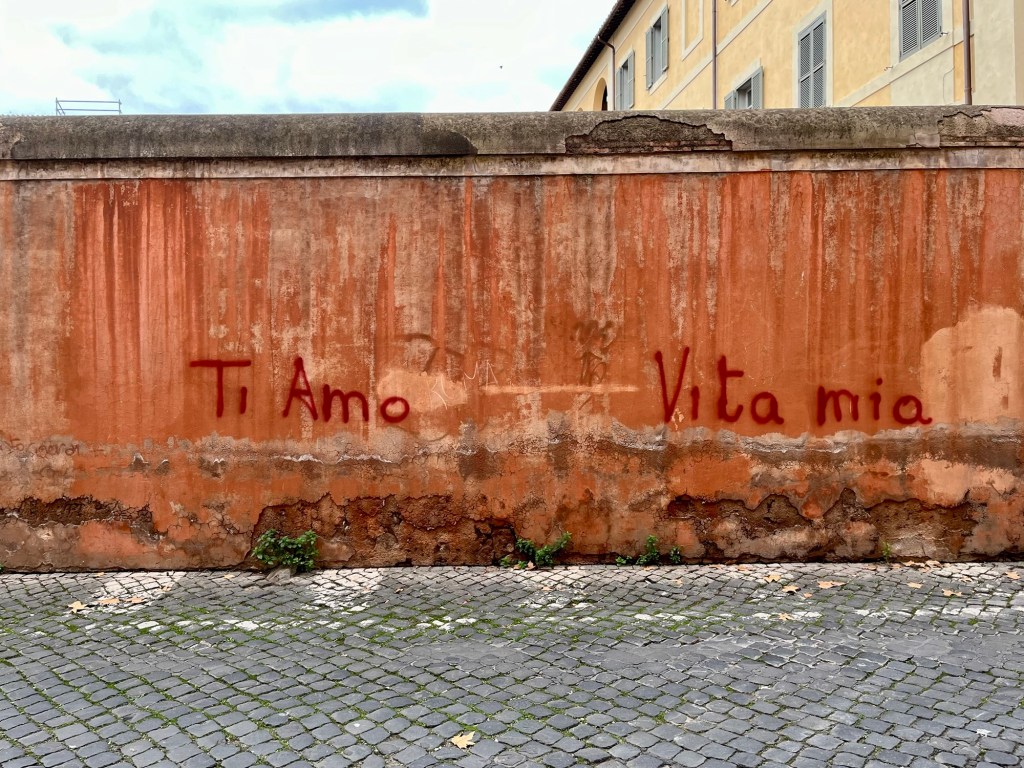
Parole scoperte

Foto di Small Circle Big Circle

Parole scoperte,

perse,

poi ritrovate 

qui

sulla carta 

bianca e deserta.

Parole cadute 

come gocce di sudore,

o saliva filante,

o lacrime involontarie.

Parole scritte

per capire,

per pensare,

per scoprire

la realtà delle cose,

nelle cose stesse.

Parole lette

per poter vivere,

per poter essere,

per poter rispondere

a quella mano che bussa

insistente e violenta.

E per poi poter dire

un giorno:

“Arrivo, arrivo!

Adesso apro.”

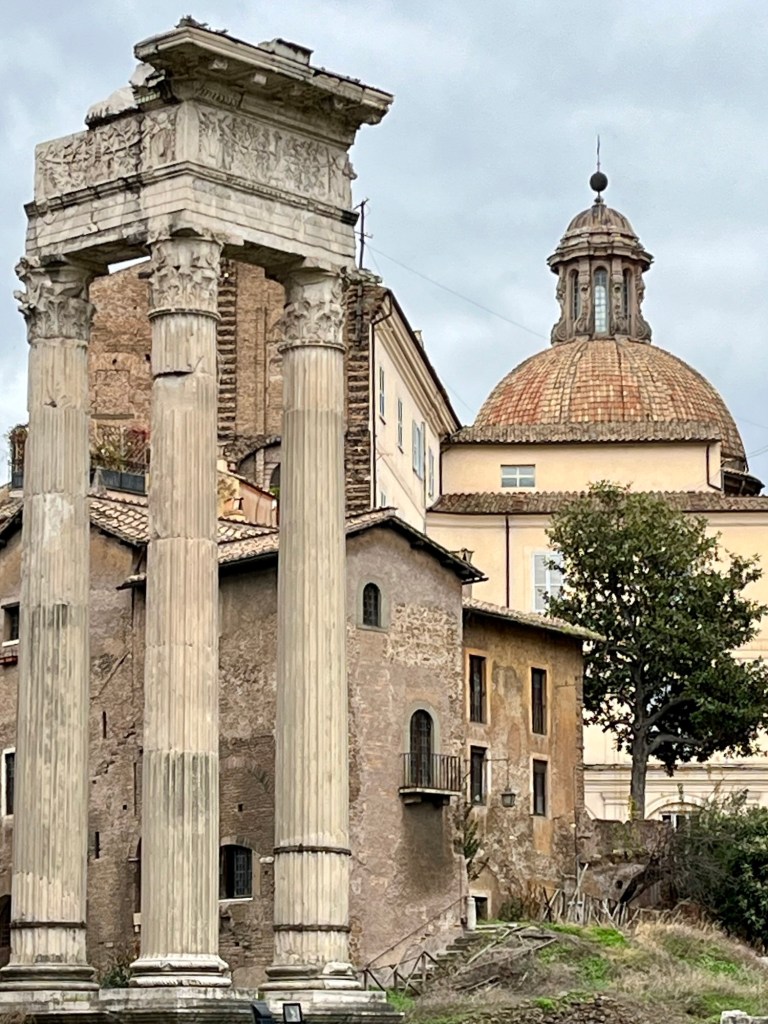
Archeologia

Di Small Circle Big Circle

Foto di Small Circle Big Circle

Nelle strade di Roma,

nelle vie, nei vicoli e nei vicoletti,

nelle piazze e nelle piazzette,

sulle fontane,

fra le statue e fra i ruderi,

nelle chiese,

sui muri rosa, gialli,

e su quelli arancioni,

ai mercati e sui palazzi antichi,

sui monumenti e 

sulle scalinate di marmo

sporco o restaurato, 

sempre

mi ritrovo 

alla ricerca

di qualche avanzo di storia.

Della mia storia.

Di qualche traccia del 

mio

passato.

O di impronte 

da me 

lasciate.

o di qualche 

mia 

forma

fossilizzata 

dal tempo.

Ma

in mezzo a così tanta 

storia non mia

mi sembra di trovare

solo qualche ricordo

futile

occasionale

che 

come il rumore di un motorino

appena lo si avverte

scompare 

subito

nel nulla.

To Emily Dickinson

To Emily Dickinson

by Small Circle Big Circle

Sister,

you are to me.

Though I have never met you.

Nor have I ever heard

the sound of your voice;

nor held your hand into mine,

nor tasted the flavor

of your bread.

Sister,

you are to me.

The words you left behind,

hoping

they would be destroyed

one day,

feed me

day and night.

“It is not the words,” someone said

“but the power within them,

the light, the truth in them

is what gives them life.”

Your verse, 

my sister,

is

Alive.

O

so Alive!

It breathes the known and the unknown

of the universe.

It is a constant

reflection

of Being;

in your eyes,

always so perfectly clear and distinct.

You are a sister to me.

And though I have never met you

Nor heard the sound of your voice

Nor held your hand into mine,

You walk with me,

Side by side.

And your words,

yes,

feed me

day and night.

The bread

of my every day.

The Guest House by Rumi

This being human is a guest house.
Every morning a new arrival.

A joy, a depression, a meanness,
some momentary awareness comes
As an unexpected visitor.

Welcome and entertain them all!
Even if they’re a crowd of sorrows,
who violently sweep your house
empty of its furniture,
still treat each guest honorably.
He may be clearing you out
for some new delight.

The dark thought, the shame, the malice,
meet them at the door laughing,
and invite them in.

Be grateful for whoever comes,
because each has been sent
as a guide from beyond.

– Rumi

by Small Circle Big Circle

How to be a poet by Wendell Berry

(to remind myself)

i   

Make a place to sit down.   

Sit down. Be quiet.   

You must depend upon   

affection, reading, knowledge,   

skill—more of each   

than you have—inspiration,   

work, growing older, patience,   

for patience joins time   

to eternity. Any readers   

who like your poems,   

doubt their judgment.   

ii   

Breathe with unconditional breath   

the unconditioned air.   

Shun electric wire.   

Communicate slowly. Live   

a three-dimensioned life;   

stay away from screens.   

Stay away from anything   

that obscures the place it is in.   

There are no unsacred places;   

there are only sacred places   

and desecrated places.   

iii   

Accept what comes from silence.   

Make the best you can of it.   

Of the little words that come   

out of the silence, like prayers   

prayed back to the one who prays,   

make a poem that does not disturb   

the silence from which it came.

Three by small circle big circle

As it fell upon a Day

AS it fell upon a Day,
In the merry Month of May,
Sitting in a pleasant shade,
Which a grove of Myrtles made,
Beastes did leap, and Birds did sing,
Trees did grow, and Plants did spring:
Every thing did banish mone,
Save the Nightingale alone.
Shee (poor Bird) as all forlorne,
Leand her breast up-till a thorne,
And there sung the dolefulst Ditty,
That to heare it was great Pitty,
Fie, fie, fie, now would she cry
Teru, teru, by and by:

That to hear her so complaine,
Scarce I could from teares refraine,
For her griefes so lively showne,
Made me thinke upon mine owne.
Ah (thought I) thou mournst in vaine,
None takes pitty on thy paine:
Senselesse Trees, they cannot heare thee,
Ruthlesse Bears, they will not cheer thee.
King Pandion, he is dead.
All thy friends are lapt in Lead.
All thy fellow Birds doe sing,
Carelesse of thy sorrowing.

Whilst as fickle fortune smild,
Thou and I, were both beguild.
Every one that flatters thee,
Is no friend in misery.
Words are easie, like the wind,
Faithful friends are hard to find;
Every Man will be thy friend,
Whilst thou hast wherewith to spend:
But if store of Crowns be scant,
No man will supply thy want.
If that one be prodigal,
Bountiful they will him call:
And with such-like flattering,
Pity but he were a King.

If he be addict to vice,
Quickly him they will intice.
If to women he be bent,
They have at Commaundement.
But if Fortune once do frown,
Then farewel his great renowne.
They that fawn’d on him before,
Use his company no more.
He that is thy friend indeed,
He will helpe thee in thy need.
If thou sorrow, he will weep;
If thou wake, he cannot sleep.
Thus of every grief in heart,
He with thee doeth beare a part.
These are certain signs to know
Faithful friend from flatt’ring foe.

(attr. W. Shakespeare; probably by R. Barnfield)

Gravity’s Law by Rainer Maria Rilke

How surely gravity’s law

strong as an ocean current,

takes hold of even the strongest thing

and pulls it toward the heart of the world.


Each thing

– each stone, blossom, child –

is held in place.

Only we, in our arrogance,

push out beyond what we belong to

for some empty freedom.

If we surrendered

to Earth’s intelligence

we could rise up, rooted, like trees.

Instead we entangle ourselves

in knots of our own making

and struggle, lonely and confused.

So, like children, we begin again

to learn from the things,

because they are in God’s heart;

they have never left him.

This is what the things can teach us:

to fall,

patiently to trust our heaviness.

even a bird has to do that

before he can fly.

Rainer Maria Rilke Rilke’s Book of Hours: Love Poems to God New York: Riverhead, 1996 (Translated by Anita Barrows and Joanna Macy)

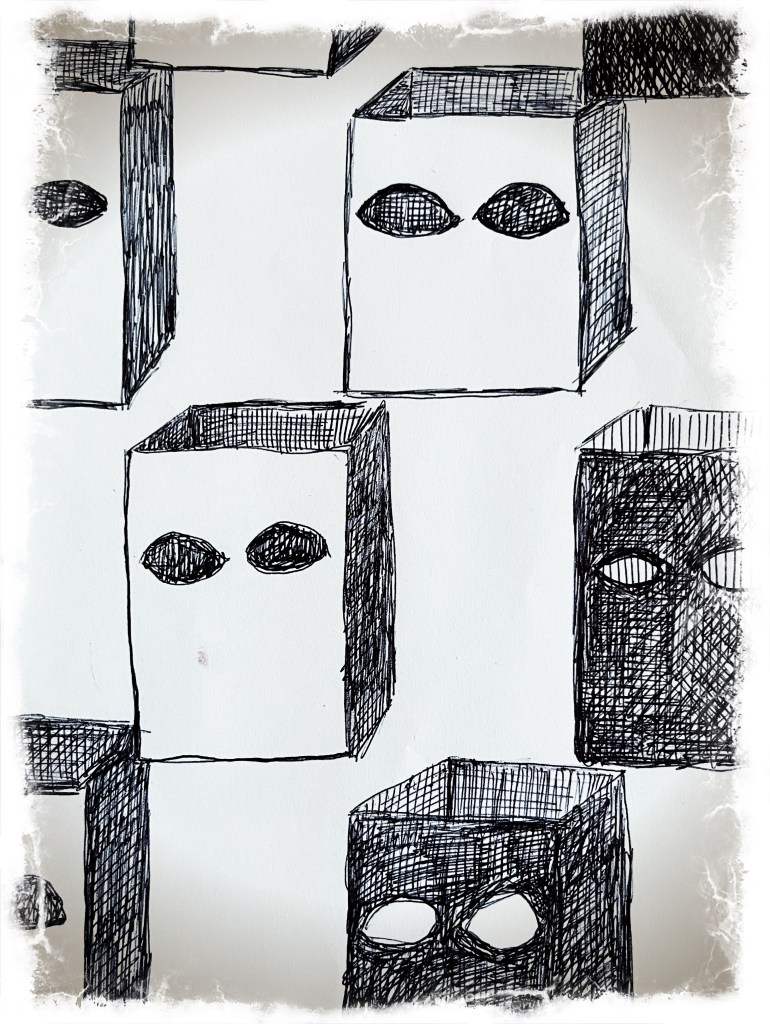
Vase by Small Circle Big Circle

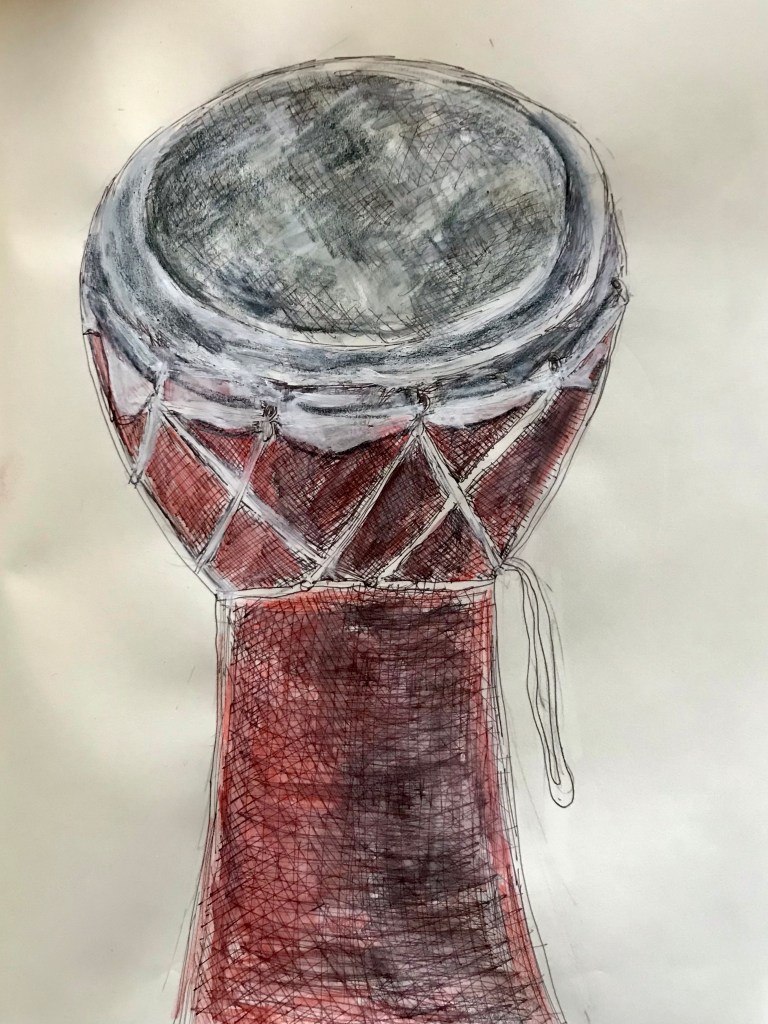
Kalinda by Gabriel Toussaint Guillaume

Drawing by Small Circle Big Circle
Kalinda

Listen friends, yes you have to listen:

Dance, the best way you can,
It’s thanks to the sounds of the drum.

Dance, the best way you know how,

You can dance as much as you can…

It’s thanks to the sounds of the drum,

Oh, how beautiful
Without which, there would not be any dancing.


Dance, the best way you know how,

It’s thanks to the sounds of the drum.


Oh how beautiful it would be,

If everyone could find a drum.


Ayibobo! (Victory cry)


The apple does not fall far from the tree;

All good things derive from good things

Thank you, drumbeats.


It is thanks to the sounds of the drum.


Ayibobo! (Victory cry)

– Original text in Creole by Gabriel Guillaume and translated into English by: Lodz Deetjen

Mezanmi tande, wi se poun tande: Kalinda, jan ou ka kalinda,
Se gran mesi kout tanbou.


Kalinda, jan ou ka kalinda, Ou te mèt byen banda…
Se gran mesi kout tanbou, San li pata gin Kalinda.


Oh, Ala bèl, wi sa ta bèl,
Oh bèl, oh bèl,
Si tout moun teka jwen tanbou.


Ayibobo!


Kalinda, jan ou ka kalinda, Se gran mesi kout tanbou,


Joumou pa donnin kalbas,
Zannanna pa donnin pengwen;
Tout bon bagay, se prodwi bon bagay. Tout sa ki byen, soti nan sa ki byen. Mèsi kout tanbou, gran mèsi kout tanbou.


Ayibobo!


-Gabriel Toussaint Guillaume

Que signifie la chanson Kalinda?


L’Homme peut accomplire des choses merveilleuses et se vanter meme de reussites spectaculaires. Mais en realite, tout vient du createur.
Tous dons et toutes richesses sont des faveurs divines qui doivent servir du bien-etre de tous. Rendons grace a Dieu et partageons genereusement.


– Gabriel Toussaint Guillaume


What does the song Kalinda mean?


Humans can make wonders and can even be proud of spectacular accomplishments; but in reality, everything comes from The Creator.
All talents and all treasures are divine blessings that must be used to the benefit of all. Let’s praise God and let’s share generously.

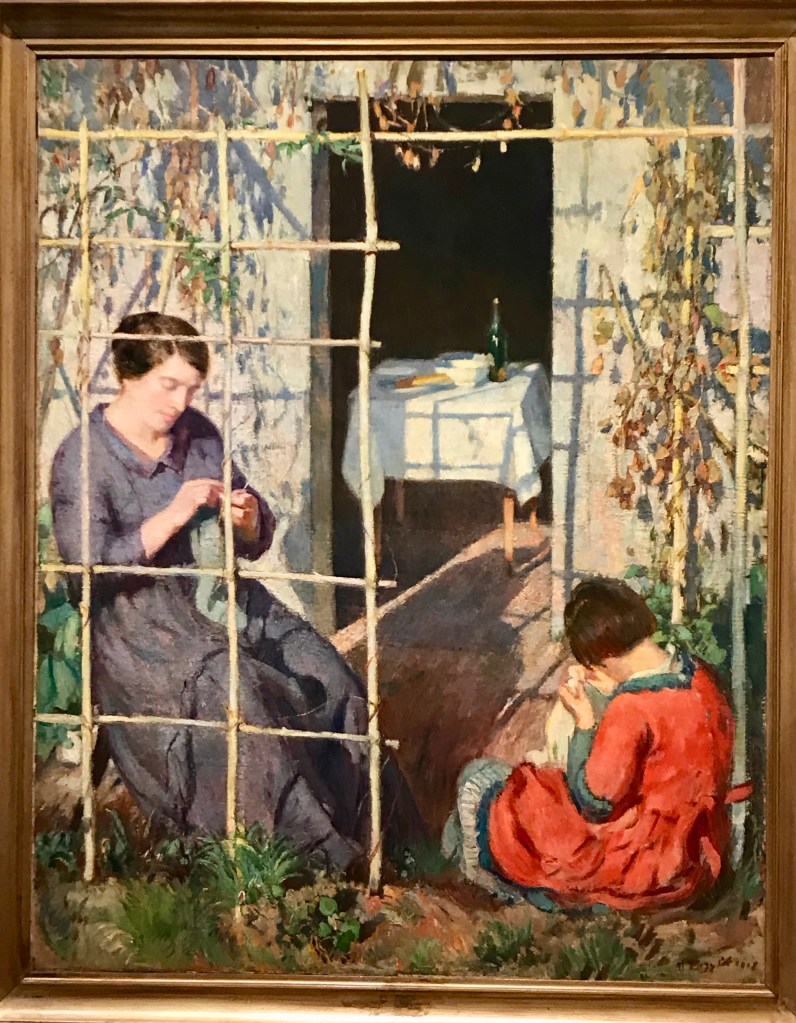
La casa dell’artista – The Artist’s House

La casa dell’artista, olio su tela di Umberto Moggioli, 1918

The Artist’s House, Oil on canvas, 1918

I saw this painting in July, while in Venice. I love the light and the warmth it radiates. I love how the mother and the daughter are working so attentively and with such focus. Yet, they are clearly enjoying each other’s company. There is a great sense of peace and comfort. There is a great sense of welcome: the door is open and the table is set. Such beauty and simplicity.